Session Levels indicator
The reference prices active traders watch every day, drawn automatically and computed in US Eastern time no matter what time zone your chart uses. Labels sit at the chart edge so they never cover the candles.
Not sold separately: every Holdout indicator and both strategies come in one plan, $39 a month. See pricing or start with the free Session Levels Lite.
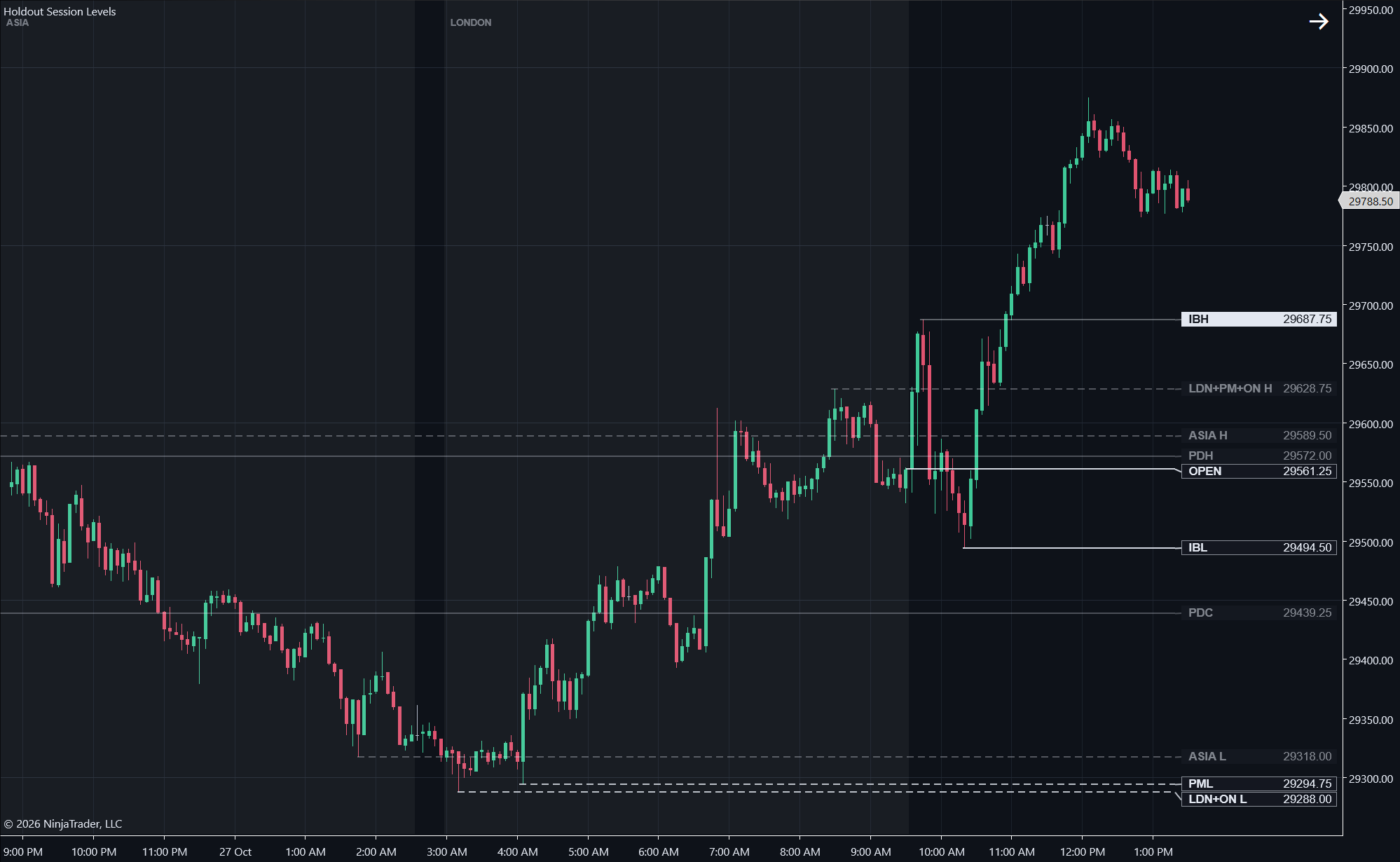
What it draws
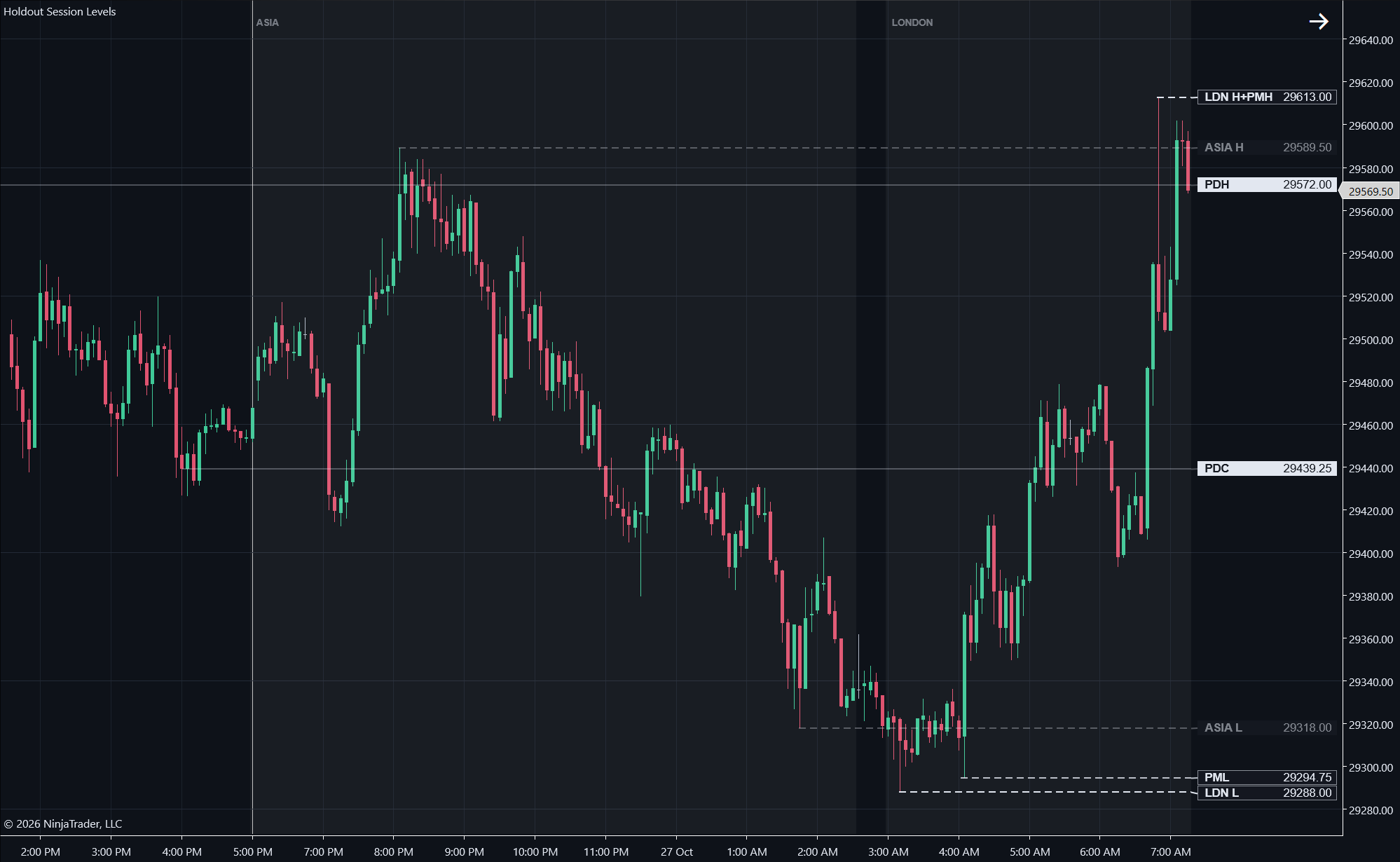
Asia, London and premarket ranges
Asia (18:00–02:30), London (03:00–09:30) and premarket (04:00–09:30), each with its own high and low. During those sessions the indicator follows the range that is still forming.
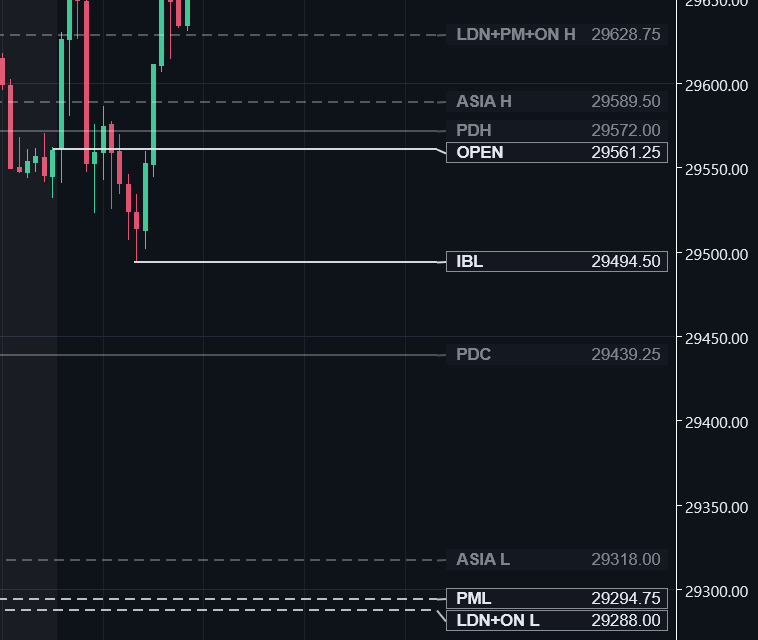
Smart grouping keeps it readable
Overnight levels often sit on top of each other. The overnight high and low are the main lines; an Asia, London or premarket extreme only gets its own line where it's actually different, so you don't get a stack of labels on one price.
Prior-day high, low and close
Yesterday's regular-session (09:30–16:00 New York time) high, low and close, the three prices most day traders mark before the open. They're computed from the regular session only, so an overnight spike doesn't move them.
Overnight high and low
The range from the 18:00 reopen to the 09:30 open. Where the open sits against this range, inside it, above it or below it, tells you a lot about the first hour.
Initial balance and the open
The high and low of the first hour (09:30–10:30), and the regular-session open price. The initial balance is where many traders judge whether the day will range or trend.
Prior week high and low
Last week's high and low stay on the chart all week as the bigger reference levels.
Right in New York time on any chart
Session windows are calculated in US Eastern time whatever time zone your chart uses, so the 09:30 open is right on a chart set to Chicago, London or Tokyo time.
One column of labels, one colour
Each line starts at the bar that set the level and ends at its label in one column at the right edge, name and price, never overlapping. One colour and four line styles: today's levels solid, the prior day thin, session ranges dashed, the prior week dotted. The nearest level above and below price is filled in, and a level price has already traded through fades. Other Holdout indicators put their levels in the same column.
Full feature list
- Prior-day regular-session (09:30–16:00 ET) high, low and close
- Overnight high and low (18:00–09:30 ET)
- Asia (18:00–02:30), London (03:00–09:30) and premarket (04:00–09:30) ranges
- Initial balance (09:30–10:30) and the regular-session open
- Prior-week high and low
- Session-adaptive: during Asia or London it focuses that session's developing range
- Smart grouping: the overnight high/low is the main line; Asia, London or premarket extremes show only where they differ
- Per-level toggles; one colour with four line styles, labels in one column at the right edge, off the candles
How it works
Every level is built from completed bars, so a level never moves after it is drawn.
Session windows are calculated in Eastern time. A chart set to Chicago, London or Tokyo time still gets the 09:30 open right.
Use an extended-hours (ETH / 24-hour) chart so the overnight sessions have data.
Good to know
- Levels show where price tends to react, not which way it will go. Use them as context for your own entries rather than as automatic buy or sell signals.
- Works on any symbol. The Asia, London and overnight ranges need a market that trades outside regular hours (futures, forex, crypto) on an extended-hours chart; on stocks, the premarket range covers the same ground.
Questions
Which session times does it use?
Does it repaint?
Is it free?
All 14 Holdout tools, one plan
Session Levels plus every other indicator and both strategies for $39 / month or $349 / year, or $599 once.